
Gender Transition in Belarus: Step-by-Step Guide
Updated November 30, 2025
According to the latest information, urologist Arkady Alexandrovich Gres is on medical leave from July to December 2025. He is being replaced by urologist Dmitry Mikhailovich Nitkin, but as far as we know, no one has yet managed to schedule an appointment with him.
TG House has tried to provide the most comprehensive overview of the main steps required for a gender transition.
*A gender transition is a process in which a person changes their legal sex or brings their appearance into alignment with their gender identity, which differs from the one assigned at birth.
The transition procedure is regulated by Resolution No. 163 of the Ministry of Health of the Republic of Belarus dated December 9, 2010, “On Certain Issues of Changing and Correcting Sexual Affiliation,” and only citizens of Belarus are eligible to start it.
The official procedure consists of two stages. The first grants the right to change the gender marker in the passport, and the second provides access to hormone therapy and gender-affirming surgeries. In both cases, the minimum observation period is one year, and the final decision is made by the “Interdepartmental Commission on Medical, Psychological, and Social Rehabilitation of Persons with Gender Identity Disorder” under the Ministry of Health of the Republic of Belarus. Thus, completing both commissions will take at least two years.
It’s also worth noting that the specific details and duration of the procedure vary from person to person.
First stage — changing the passport sex marker
STEP 1.
You need to schedule an appointment with psychiatrist–narcologist Aleksandra Anatolyevna Kuchinskaya at the State Institution “Republican Scientific and Practical Center for Mental Health.”
The center is located in Minsk at: Dolginovsky Trakt 152.
Phone number for scheduling an appointment with Kuchinskaya A.A.: +375 17 221-32-02 (It’s best to call on weekdays between 9:00 and 14:00).
The doctor receives patients in Building 8, Room 223 (as of February 1, 2024).
What to bring: your passport, a copy of the main passport pages, and 3 photographs (from ages 5–6, 10–12, and a recent one). If you don’t have the photos, simply inform the doctor.
During the first appointment, the psychiatrist–narcologist will create a medical record and attach copies of your passport pages.
The psychiatrist–narcologist will explain in detail the stages of medical and psychological examination and monitoring, warn about possible complications related to hormone therapy and surgical transition, and ask you to sign the medical record confirming that you have been informed about the potential consequences of transitioning.
The doctor will also offer you the opportunity to talk about yourself. The questions are general, and no special preparation is required.
At the end of the first appointment, the psychiatrist–narcologist usually provides referrals for all examinations required for the commission. These include:
- A psychological assessment with a psychologist at the same center.
- A medical-psychological examination at the Center for Mental Health (inpatient).
- A consultation with a urologist (or gynecologist).
- An endocrinological assessment.
- A karyotype test.
If you do not receive all referrals at once, don’t worry — the doctor will issue the rest during subsequent visits.
The psychiatrist–narcologist will also give you a questionnaire to complete at home and bring to the second appointment.
STEP 2.
Visit psychologist Maksim Ignatovich at the Center for Mental Health. He receives patients in Building 8, Room 136.
Phone number: +375 17 385-90-27, but as of July 31, 2024, NO APPOINTMENT IS REQUIRED — you can simply come during working hours.
You will need to take two psychological tests; only after this will you be officially placed under observation at the Center for Mental Health.
Then, for the duration of one year, you must visit both the psychologist and the psychiatrist–narcologist at least once every three months.
What does the psychologist ask?
Identity and self-understanding: The psychologist may ask how you identify your gender, what feelings and thoughts you have regarding it, and what experiences you’ve had in realizing you were “in the wrong body.”
History: The psychologist may ask about your past experiences, including when you became aware of your gender identity, the emotional and social aspects of this process, and the reactions of people around you and your family.
STEP 3.
Undergo an inpatient examination at the Center for Mental Health.
You will need to stay in the hospital for 7 to 14 days. You will be provided with a free private room in Department 20. You may bring your phone or computer, and some people even manage to continue working remotely during this period.
Phone number for scheduling: +375 17 251-67-33. It's best to call between 11:30 and 13:00.
The staff is generally very friendly. This is not treatment — it is an examination, so there will be no medications or injections. You will undergo general tests (CBC, urinalysis), ECG, EEG, and consultations with a neurologist and psychologist.
At the end of the examination, you will have a consultation with an associate professor. They will then prepare a conclusion, which typically includes the diagnosis “Transsexualism” (F64.0).
STEP 4.
Take a free karyotype test at the RSPC “Mother and Child”.
The center is located in Minsk at: Orlovskaya St. 66, Building 9 (follow Orlovskaya toward the gas station to the end of the fence, then turn right toward the nine-story building).
No appointment is required for the karyotype test. You can come on weekdays with your referral and passport (optional but recommended) between 8:00 and 14:00 to Room 926.
Phone number for inquiries: +375 17 232-45-54
*A karyotype is the complete set of characteristics of a chromosome set (shape, size, quantity) typical for a biological species. The test identifies genetic features as well as chromosomal abnormalities.
The doctors treat patients respectfully but may ask about your transition process. After your blood is drawn, you will receive instructions explaining that ten days later you should call to learn whether the analysis was successful. If everything is fine, you will receive an analysis number and will need to call approximately once a month to check whether the results are ready. If the analysis is unsuccessful, you will need to repeat the test.
STEP 5
Undergo an examination by a urologist (for transfeminine people) or gynecologist (for transmasculine people):
The gynecologist works at City Clinical Hospital No. 1, Women’s Consultation No. 4.
The center is located in Minsk at: Nezavisimosti Ave. 64
Phone number for scheduling: +375 17 379-94-25
You must book an appointment with the head physician. After the examination, the conclusion is issued immediately.
The urologist works at the Minsk Regional Clinical Hospital (BelMAPO department).
Located at: Minsk Region, Minsk District, Lesnoy, 1
Phone number for scheduling: +375 17 265-25-61
You must book an appointment with Arkady Alexandrovich Gres. The doctor receives patients in the therapeutic building of the MRCH.
Finding the urologist’s office is easy, as his full name (Gres A.A.) is listed on the door. During the visit, the doctor will ask questions about your referral, details of your sexual history, hormone use, awareness of hormone-related risks, and your desire or unwillingness to undergo surgery after changing documents.
The genital examination is visual only, without physical contact. After the examination, the doctor will issue a conclusion and wish you good luck.
STEP 6
Visit an endocrinologist at the Republican Center for Rehabilitation and Balneotherapy.
The center is located in Minsk at: Makaenka St. 17.
Phone number for scheduling: +375 17 215-27-70
+375 29 686-27-70 A1,
+375 29 249-97-70 MTS
First, you need to schedule an appointment with any endocrinologist, who will issue referrals for lab tests. On average, the results take about one month.
Once the tests are ready, you must visit the endocrinologist again, after which they will schedule your appointment with the head physician for the final conclusion.
What does the endocrinologist ask?
Mainly, the doctor will ask whether you have taken hormones without medical supervision and will explain the risks of uncontrolled use of such medications.
You may be surprised to learn that medical students may be present during the appointment.
STEP 7
Obtain an extract from your outpatient medical record at your local clinic.
STEP 8
Once you have collected all documents (tests, extracts, examination results), you must visit the psychiatrist–narcologist again and wait for the appointment of the first commission, which will take place no earlier than one year after being placed under observation.
STEP 9.
Receive the decision of the interdepartmental commission under the Ministry of Health.
The commission of 8–10 doctors and one representative of the Ministry of Internal Affairs meets twice a year to consider the need for a change of sex and to issue the final diagnosis “Transsexualism” (F 64.0). The commission materials are prepared by the secretary — the psychiatrist–narcologist of the Center for Mental Health. They also inform you about the date and location of the meeting.
The commission composition as of November 2022 included: professor of the BSMU Endocrinology Department Alla Shepelkevich, head of the Leninsky District Police Department of Minsk Vitaly Kapilevich, head of the Main Directorate for Medical Care of the Ministry of Health Aleksei Shcherbinsky (commission chair), plastic surgeon Vladimir Podgaisky, associate professor of the BelMAPO Department of Obstetrics, Gynecology, and Reproductive Health Leonid Neden, associate professor Mikhail Vazhenin, commission secretary Maksim Podolyak, and several psychiatrists and addiction specialists.
The commission may deny the transition if the patient has medical contraindications listed in paragraph 6 of the Instructions on the Procedure for Changing and Correcting Sexual Affiliation.
Over the past year, only 20–25% of candidates received a positive decision. In case of refusal, you must visit the psychiatrist–narcologist again to prepare for the next commission.
Second stage — obtaining permission for hormone therapy and gender-affirming surgery
Preparation for the second commission includes only dynamic observation by the psychiatrist–narcologist and psychologist, with visits to both specialists at least once every three months.
You need to schedule an appointment with a psychiatrist–narcologist at the State Institution “Center for Mental Health.”
The center is located in Minsk at: Dolginovsky Trakt 152.
Phone number for scheduling: +375 17 385-90-27 (It’s best to call on weekdays between 9:00 and 14:00).
The doctors receive patients in Building 8 (as of June 17, 2023).
After receiving a positive decision from the second commission, you have the right to begin hormone therapy under the supervision of an endocrinologist at the Republican Center for Rehabilitation and Balneotherapy, and to undergo gender-affirming surgery at the Minsk Regional Clinical Hospital in Borovlyany.
How to schedule surgery?
Surgery for both MTF and FTM patients is performed by plastic surgeon Sergei Sergeevich Mechkovsky in the Department of Microsurgery and Plastic Surgery (2nd Therapeutic Building) of the Minsk Regional Clinical Hospital (Minsk District, Lesnoy, 1).
Phone numbers for scheduling: +375 17 517-77-55, +375 17 515-55-77 (paid services).
You must bring a referral from the psychiatrist–narcologist at the Center for Mental Health and the decision of the second commission.
For postoperative recovery, you may stay either in a free 4-bed room or a paid 2-bed room. The cost of a paid room is 30 BYN per day.
Surgeries for Belarusian citizens are free of charge. MTF patients only need to pay for breast implants (purchased independently).
What to bring to the hospital?
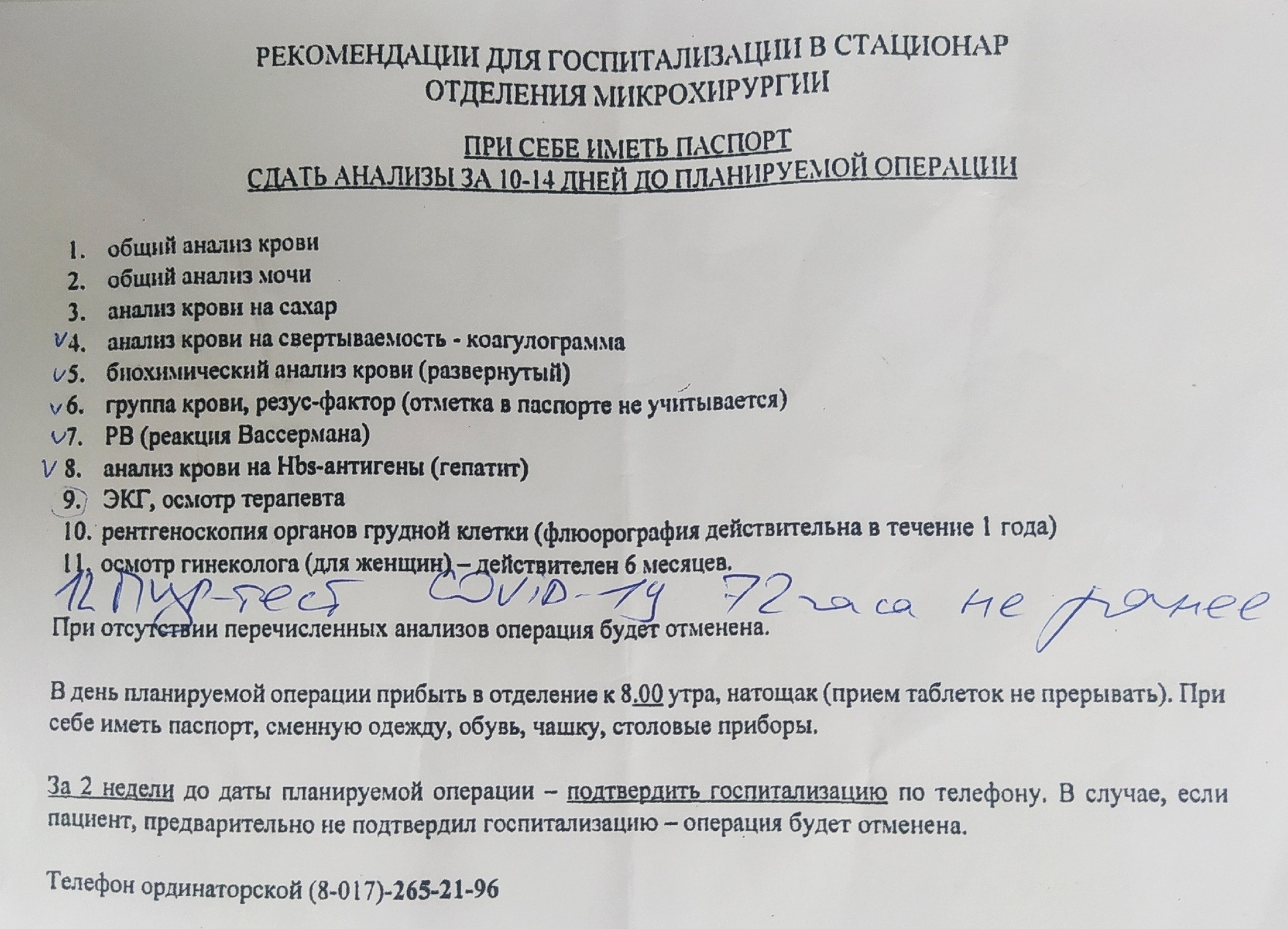
For MTF: Class 1 compression surgical stockings without heel and toe, at least 20 condoms (preferably 90 for the entire recovery period), 3 tubes of Levomekol ointment (preferably 10 for further home treatment), 3 bottles of 200 ml chlorhexidine (preferably 10 for later use), wet wipes, disposable bedsheets, bottled water for 14 days (2 liters per day, bottles no larger than 2.5 liters), wide surgical tape, a spacer (dilator), one or two adult diapers (upon discharge, the urinary catheter may be removed and frequent urges may occur), and paper towels. It’s also helpful to bring loose pants so the spacer isn’t visible when traveling home from the hospital.
You should also bring slippers, a robe, shampoo, soap, toothpaste and toothbrush, a hairbrush, and a mug. Additionally, chocolates for the nurses (4 shifts) will be very welcome.
If you still have questions, write to us.